
LLM Evaluation: Metrics, Benchmarks & Human Validation Explored
Published date: 19.05.2026
Read time: 7 min
Effective evaluation of LLM outputs is key for modern AI systems to be accurate, safe, and reliable. As organizations increasingly adopt generative AI, structured testing and validation processes help identify hallucinations, improve performance and reduce risk. In this guide, we cover the basics of large language model evaluation, the most important metrics and benchmarks, and methods used for human validation of real-world AI systems.
LLM Evaluation is the process of assessing and measuring the performance of Large Language Models (LLMs). It involves various techniques and metrics to evaluate different aspects of an LLM’s capabilities, such as its accuracy, fluency, coherence, bias, fairness, robustness, and more. LLM Evaluation helps researchers, developers, and users understand the strengths and weaknesses of an LLM, compare different models, and make informed decisions about their use in various applications. It also helps identify areas for improvement and guide the development of better models. Overall, LLM Evaluation plays a crucial role in ensuring the reliability, safety, and ethical use of LLMs.
The evaluation of LLMs includes measuring their performance on tasks such as reasoning, summarization, coding, and question answering. Effective llm testing helps organizations validate accuracy, safety, consistency, and relevance before deploying the model.
Why LLMs need evaluation

Proper LLM validation is necessary to prevent AI systems from producing misleading, biased, or harmful outputs. Evaluation frameworks help organizations improve reliability, benchmark models, identify hallucinations, and remain compliant in customer-facing applications.
Challenges of evaluating large language models
Unlike traditional software, language models produce probabilistic outputs, however, which makes evaluation more subjective. Common challenges include limits of benchmarks, bias in data sets, the scaling of human review, and the measurement of contextual understanding.
Key Metrics in LLM Evaluation
Organizations use a number of LLM evaluation metrics to measure model quality.
- Precision & Relevance – Accuracy measures factual correctness, while relevance and coherence measure whether the response adequately addresses the prompt in a logical and readable way.
- Safety and Detection of Hallucinations – Llm quality assurance focuses on safety, including toxicity, harmful content, privacy risk, and bias. In the meantime, llm hallucination detection detects fake or unsupported information.
- Latency & Performance – And in technical evaluation, there’s response speed, throughput, token efficiency, and infrastructure costs, especially for enterprise-scale AI systems.
Common LLM Benchmarks
Several standardized LLM benchmarks are widely used to compare the model performance.
- MMLU – MMLU tests reasoning and knowledge in subjects such as science, law and history.
- HELM – HELM is a set of metrics to evaluate language models on things such as accuracy, fairness, and robustness.
- BIG-bench and HumanEval –BIG-bench tests advanced reasoning skills. HumanEval tests coding skills through executable programming tasks.
Human Evaluation of LLMs

Automated metrics are not able to capture all aspects of language quality. “Human review still plays a role in modern ai model evaluation workflows.
Human Preference Evaluation – In human evaluation, reviewers rank LLM system outputs by clarity, helpfulness, and factuality.
Human-in-the-Loop Systems – Human in the loop LLM systems use automated monitoring and human oversight to enhance model alignment and reduce errors over time.
Automated vs. Human LLM Evaluation
The speed, scalability and consistent scoring make automated evaluation useful for regression testing and benchmark comparisons. Human evaluation is contextual and can capture subtlety of reasoning or tone.
The best evaluation strategies for large language models use a combination of both to balance efficiency and accuracy.
Guidelines for Trustworthy LLM Evaluation
Organizations need to set clear evaluation criteria, use a blend of automated and human evaluation, bring in domain experts as needed, and monitor model performance after deployment.These practices tend to yield more reliable, less hallucinated and better long-term performance of AI.
LLM Evaluation Use Cases
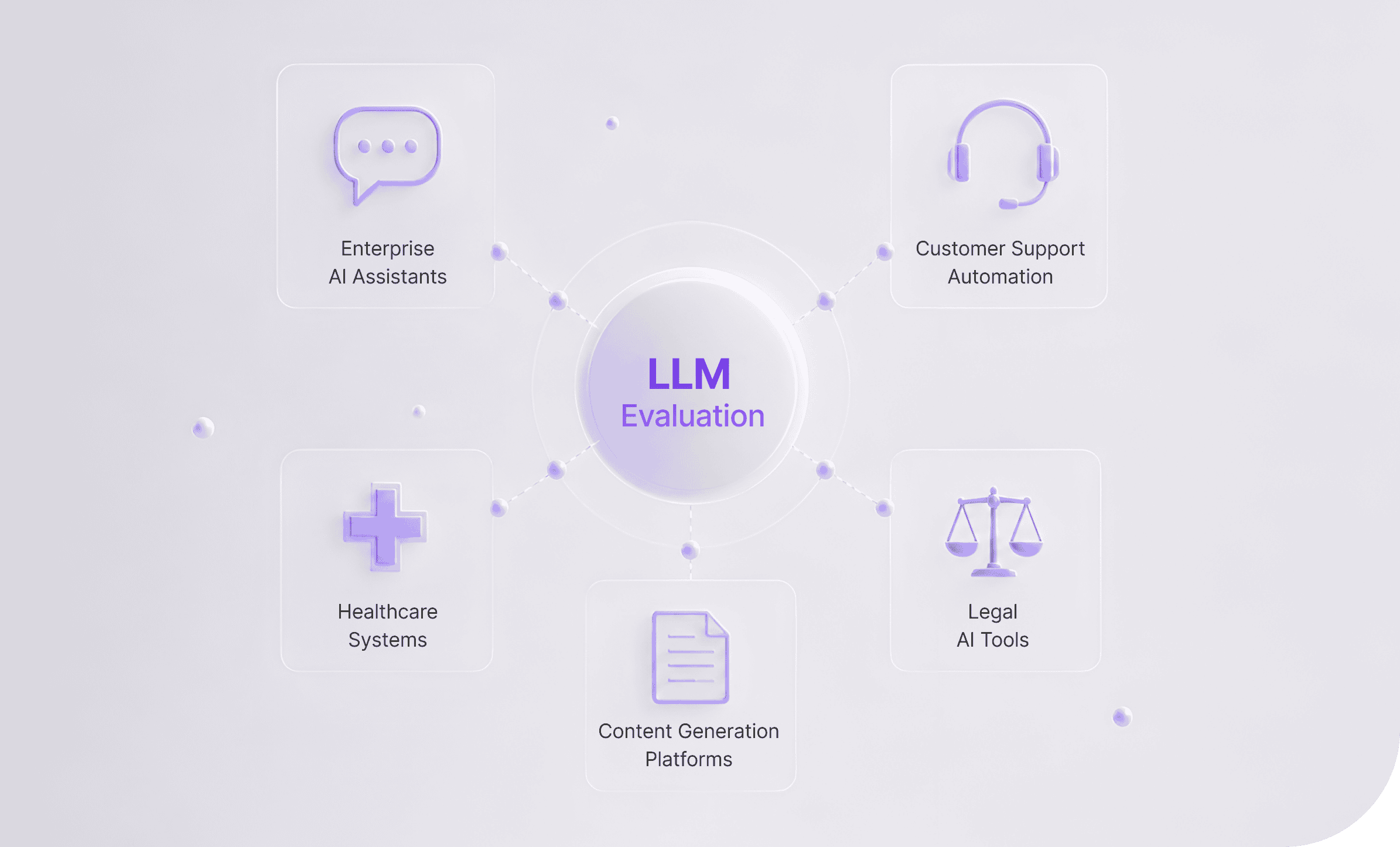
In the real world, businesses use LLM evaluation in enterprise AI assistants, customer support automation, healthcare systems, legal AI tools, and content generation platforms. Strong LLM testing processes in sensitive sectors help to reduce the spread of misinformation and the risk of non-compliance.
The Use of Human Feedback in LLM Evaluation
Human feedback is crucial to improve modern language models. Reinforcement Learning from Human Feedback (RLHF) leverages ranked human preferences to enhance response quality and alignment. Human reviewers also help reduce hallucinations and improve trustworthiness, by flagging outputs that are unsupported or unsafe.
How Mindy Support Manages LLM Evaluation
Mindy Support improves the reliability of AI through automated monitoring and scalable human validation workflows. Before deployment, domain experts and enterprise QA pipelines review industry-specific outputs for hallucinations, safety concerns, and compliance risks.
By combining expert-in-the-loop evaluation with flexible QA operations, Mindy helps companies launch AI products with greater confidence, accuracy, and consistency. Our workflows are designed to scale across different domains and use cases, enabling teams to quickly identify model weaknesses, improve response quality, and maintain high performance standards over time.
To learn more about our approach to AI quality assurance and model validation, visit our LLM Evaluation page.
Conclusion
Effective evaluation of LLMs is critical in building trustworthy AI systems. By combining automated benchmarks, human review and continuous monitoring, organizations can improve model reliability, reduce hallucinations, and provide safer AI experiences. As adoption grows, companies investing in robust large language model evaluation and scalable LLM validation processes will be much better positioned to roll out high-performing AI solutions.
FAQ: Evaluating LLMs
- What is the evaluation of LLMs?
Evaluation of LLMs measures the performance of a language model on accuracy, safety, reasoning, and performance metrics.
- Why do we need human evaluation?
Automated systems can miss contextual errors, hallucinations, and tone issues that human reviewers can see.
- What are common LLM benchmarks ?
Popular benchmarks are MMLU, HELM, BIG-bench, and HumanEval.
TOP ARTICLES





FOLLOW US ON OUR SOCIAL NETWORKS


