
Build an AI Model
Start from the ground up with the right data, training strategy, and expert support to build a high-performing AI model.

From building and training new AI models to fine-tuning existing ones, we provide the expertise and infrastructure required at every stage.
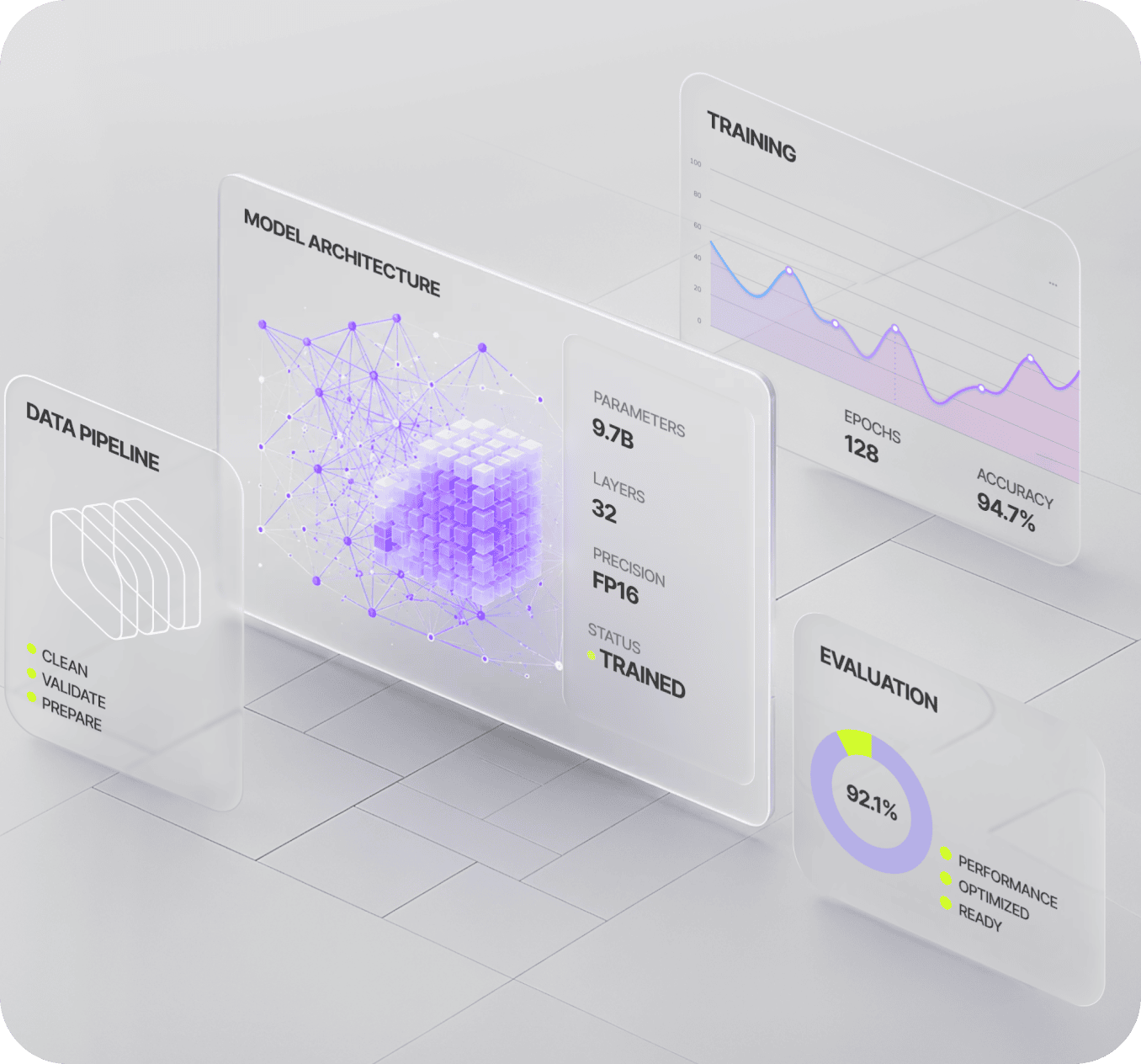
Start from scratch or optimize what you have with the right data, expert support, and AI training solutions built to move your projects forward.
Start from the ground up with the right data, training strategy, and expert support to build a high-performing AI model.

Identify performance gaps and optimize your existing model with targeted data, human + AI feedback, alignment, and evaluation.


A secure environment for human + AI feedback, preference ranking, model evaluation, and alignment workflows.

Specialized engineering and domain expertise to train, fine-tune, evaluate, and optimize complex AI models.

250K+ contributors across 85+ languages for scalable data collection, annotation, feedback, and evaluation.
We build fully custom datasets based on your requirements









What is AI model training?
AI model training is the process of teaching an AI model to perform specific tasks using large amounts of high-quality AI training data. Depending on the project, AI model training can include data collection, AI data annotation, data labeling, model development, training, fine-tuning, human feedback, alignment, and evaluation.
How do you train an AI model?
To train an AI model, you typically start by defining the model’s objectives and data requirements, then collect, annotate, label, and curate high-quality AI training data. The process may include model training, supervised fine-tuning, human feedback, alignment, and evaluation. The exact approach depends on the model type, use case, available data, and target performance.
What is the difference between AI model training and fine-tuning?
AI model training can involve building and training a model from scratch, while AI model fine-tuning starts with an existing pretrained model and further trains it on targeted data. Fine-tuning can adapt a model to specific domains, tasks, languages, or performance requirements without requiring full training from scratch.
Can you train an AI model from scratch?
Yes. Mindy Support can support AI model development and training from data strategy and AI training data preparation through model training, supervised fine-tuning, human feedback, alignment, and evaluation.
Can you fine-tune an existing AI model or LLM?
Yes. We provide AI model fine-tuning for existing models, including LLMs. Depending on your goals, our services can include supervised fine-tuning (SFT), instruction tuning, domain adaptation, preference data, RLHF, DPO, evaluation, and other post-training workflows.
What is the difference between AI model fine-tuning and model adaptation?
Fine-tuning is a specific technique that updates a pretrained model using additional training data to improve performance on particular tasks or domains. Model adaptation is a broader concept that can include fine-tuning, parameter-efficient fine-tuning, prompt optimization, domain adaptation, retrieval integration, and alignment.
What is RLHF and how does it help train AI models?
RLHF (Reinforcement Learning from Human Feedback) is a model alignment technique that uses human preferences to improve an AI model’s behavior and responses. It typically involves collecting preference data, training a reward model or applying preference optimization, and using feedback to improve model performance.
What types of AI training data do you provide?
We provide different types of AI training data, including text, image, video, audio, multimodal, and domain-specific datasets. Our capabilities cover data collection, AI data annotation, AI data labeling, data curation, synthetic data, preference data, and quality assurance.
Do you provide AI data annotation and labeling services?
Yes. Our AI data annotation and labeling capabilities support text, image, video, audio, and multimodal AI projects. Depending on your requirements, we can provide classification, bounding boxes, segmentation, transcription, entity annotation, preference ranking, and other task-specific data labeling workflows.
How do you ensure the quality of AI training data and human feedback?
We use multi-stage quality assurance combining automated checks, AI-assisted evaluation, human review, and expert validation where required. Our human-in-the-loop AI workflows can include annotator qualification, multiple review stages, disagreement resolution, benchmarking, and ongoing quality monitoring.
What types of AI models can you help train or fine-tune?
We support a wide range of AI and machine learning use cases, including large language models (LLMs), computer vision models, speech and audio models, multimodal models, vision-language models, and AI systems for robotics and physical AI.
Do you support multimodal AI model training and evaluation?
Yes. We support multimodal AI workflows involving text, images, video, and audio, including vision-language models and other multimodal systems. Services can cover AI training data collection and annotation, multimodal evaluation, human feedback, safety testing, and model performance assessment.
